


The Research Behind FLOW
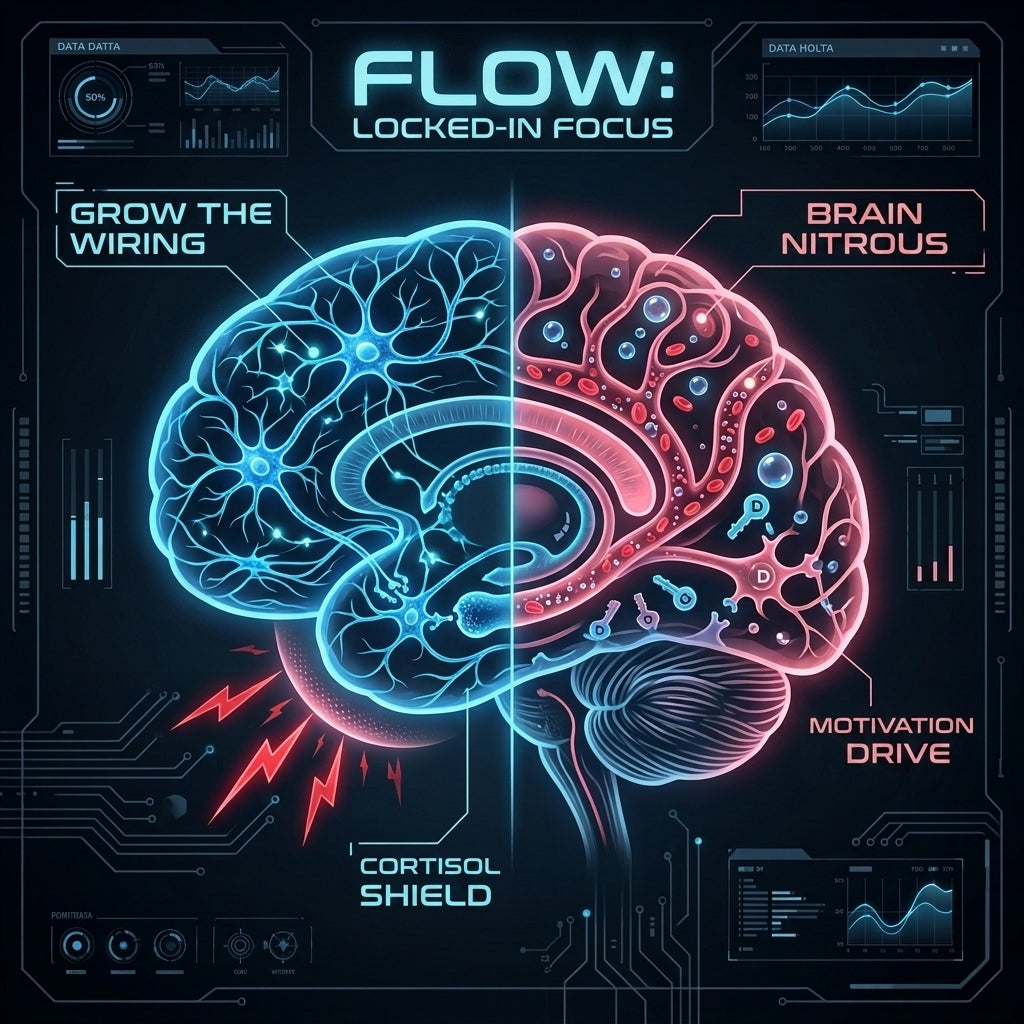

Neurotransmitter Support
Human RCT (Bacopa)
Neurogenesis & NGF
Preclinical (Lion's Mane)
Cerebral Blood Flow
Human pilot MRI (Ginkgo)
Stress Buffer (HPA Axis)
Human RCT (Ashwagandha)
Antioxidant Neuroprotection
Mechanistic/human mixed
Memory Encoding & Recall
Human RCT (Bacopa)Frequently Asked Questions
Everything you need to know about our formula, ingredients, and how it works.
Does FLOW contain caffeine?
Yes — natural caffeine from kola nut, paired with theobromine and adaptogens. Moderate, smooth, no synthetic megadose. If you're highly caffeine-sensitive, start with a half dose in the morning.
How long does FLOW take to work?
Two clocks: kola nut works within the hour. The deep ingredients — bacopa, lion's mane, gotu kola — are slow-build compounds; human trials measured results at 4–16 weeks. Judge FLOW at week 8, not day 2. (This is the #1 refund-prevention answer.)
Can I take FLOW with my morning coffee?
Yes, but count the total — FLOW adds a modest natural caffeine dose. Most customers replace their second coffee rather than add to the first.
How is FLOW different from Mind Lab Pro or Alpha Brain?
Three ways: no proprietary blends (every dose on the label), 11 ingredients across 6 pathways (most competitors cover 2–3), and a research page that shows you the actual studies — including their limits.
Can I take FLOW, CHRG, and APEX together?
Yes — designed as a stack, no ingredient overlap. Note FLOW already contains natural caffeine; CHRG is caffeine-free, so the stack keeps total stimulant load moderate.
Who should not take FLOW?
Anyone on Parkinson's medication (Mucuna's L-DOPA), blood thinners (Ginkgo), thyroid/autoimmune medication (Ashwagandha), or pregnant/breastfeeding — consult your doctor first.
What's your guarantee?
100% risk-free 30-day money-back guarantee. If you do not feel a difference in your focus, clarity, and memory, simply let us know and we will issue a full refund immediately.
Are the studies on this page about FLOW itself?
No — they studied the individual ingredients. The finished formula hasn't been clinically trialed (true of virtually every supplement). That's why we show you the ingredient evidence tier by tier.
Sources — every study cited on this page
| Page Claim | Evidence Tier | Study Citation | PubMed Link |
|---|---|---|---|
| Bacopa: learning rate, memory consolidation ↑ (12wk) | Human RCT | Stough et al. 2001, Psychopharmacology 156(4):481-4 | PubMed |
| Bacopa: retention of new information ↑ | Human RCT | Roodenrys et al. 2002, Neuropsychopharmacology 27(2):279-81 | PubMed |
| Bacopa: meta-analysis, attention/reaction time ↑ | Human RCT | Kongkeaw et al. 2014, J Ethnopharmacol 151(1):528-35 | PubMed |
| Ashwagandha: cortisol −27.9% (60 days) | Human RCT | Chandrasekhar et al. 2012, Indian J Psychol Med 34(3):255-62 | PubMed |
| Lion's Mane: cognitive scores ↑ age 50–80 (16wk) | Human RCT | Mori et al. 2009, Phytother Res 23(3):367-72 | PubMed |
| Lion's Mane: neurites 3×, axons 2×, memory ↑ (mice/cells) | Lab Research | Martínez-Mármol et al. 2023, J Neurochem 165(6):791-808 | PubMed |
| Ginkgo: CBF +15% WM / +13% GM (pilot, n=9) | Human Pilot | Mashayekh et al. 2011, Neuroradiology 53(3):185-91 | PubMed |
| Rosemary: 1,8-cineole blood level ↔ memory performance | Human Pilot | Moss & Oliver 2012, Ther Adv Psychopharmacol 2(3):103-13 | PubMed |
| Mucuna: faster/longer than synthetic L-DOPA | Human Pilot | Katzenschlager et al. 2004, JNNP 75(12):1672-7 | PubMed |
| Holy Thistle cnicin: axon growth ↑; 84.7% oral bioavailability (rats) | Lab Research | Gobrecht et al. 2024, Phytomedicine 129:155641 | PubMed |
| Holy Basil: reaction time ↑, errors ↓ | Human RCT | Sampath et al. 2015, Evid Based Complement Alternat Med | PubMed |
| Blue Butterfly Pea: spatial memory ↑, AChE inhibition | Lab Research | Rai et al. 2002, Pharmacol Biochem Behav | PubMed |
| Gotu Kola: dendritic arborization ↑ | Lab Research | Soumyanath et al. 2005, Brain Res | PubMed |