Mitolyn Review: Ingredients, Price, and What It's Missing (Plus the Alternatives Worth Considering)
Men of OrderYou've seen the ads. Maybe on Facebook, maybe sandwiched into a health article that turned out to be an ad. Mitolyn, the "mitochondria formula." Purple branding, big promises about metabolism and energy.
And now you're here, doing the smart thing, checking before you buy.
Good. That's exactly what this review is for. We're going to give you the facts: what's actually in Mitolyn, what it costs, what the evidence supports, and where it falls short—no trash talk. No fluff. And yes, we're going to compare it against alternatives, including our own formula, CHRG, using the same yardstick for both.
You'll know exactly what you're looking at by the end. Let's go.
What Is Mitolyn?
Mitolyn is a stimulant-free dietary supplement positioned around mitochondrial support and metabolism. It's sold exclusively through its official website. You won't find the genuine product on Amazon, Walmart, or GNC, and the company warns about counterfeit listings on marketplaces, which is a real problem in this category.
The basics:
- Formula: 6 plant-based ingredients, no caffeine, no synthetic stimulants
- Dose: 2 capsules daily, 30-day supply per bottle
- Price (at the time of writing, September 2026): around $69 for a single bottle, $59 per bottle in a 3-pack, $49 per bottle in a 6-pack
- Guarantee: 90-day money-back guarantee (read the fine print; the window runs from your order date, and return terms apply)
- Manufacturing: made in the USA in an FDA-registered, GMP-certified facility; non-GMO and plant-based
Credit where it's due: stimulant-free is the right call for a mitochondrial product, the guarantee is generous, and GMP manufacturing matters. This is not a scam product. The question isn't whether Mitolyn is legitimate. It's whether the formula does the full job.

Mitolyn Ingredients: What's Actually in It
Here are the six ingredients, with an honest read on each.
| Ingredient | What it is | Evidence tier |
|---|---|---|
| Maqui Berry | Anthocyanin-rich South American fruit | Antioxidant support; early-stage human research |
| Rhodiola Rosea | Classic adaptogen | Human studies on fatigue and stress resilience |
| Haematococcus (Astaxanthin) | Algae-derived carotenoid antioxidant | Human studies on oxidative stress markers |
| Amla (Indian Gooseberry) | Vitamin C and polyphenol-rich fruit | Traditional use; antioxidant human research |
| Theobroma Cacao | Cocoa flavonols | Human research on circulation and vascular function |
| Schisandra | Adaptogenic berry | Traditional use; limited modern human trials |
A few honest observations.
The ingredient choices are respectable. Rhodiola has real human research behind it for fatigue and stress. Astaxanthin is a genuinely potent antioxidant. None of this is filler.
The formula is antioxidant-heavy. Four of the six ingredients are primarily antioxidants or adaptogens. That tells you the design philosophy: protect cells from oxidative stress.
Doses are not publicly disclosed. Like many supplements in this space, Mitolyn doesn't publish exact per-ingredient amounts on its public materials. That makes it impossible to verify whether each ingredient is included at the doses used in research. This isn't unique to Mitolyn, but it's worth knowing.
What Does the Evidence Actually Support?
Here's the part most reviews skip.
The individual ingredients in Mitolyn have varying levels of research, as the table above shows. Rhodiola and Astaxanthin have the strongest human data. The others are promising but thinner.
The finished Mitolyn formula itself has no published clinical trial. This isn't an attack; it's acknowledged across independent reviews, and Mitolyn's own materials point to ingredient research rather than formula research. Ingredient evidence tells you what the parts might do. It doesn't tell you what the combination does, at these doses, in this product.
That gap is normal in the supplement industry. Very few finished formulas are ever trialed. But you should know it exists, for Mitolyn and for every alternative, including ours.

What Mitolyn Covers, and What It Doesn't
At Men of Order, we evaluate every mitochondrial supplement, including our own, against four jobs. Your mitochondria need all four to produce energy well:
- Build — signals that trigger mitochondrial biogenesis: making new mitochondria (the SIRT1/AMPK/PGC-1α pathways)
- Protect — defending mitochondria from oxidative damage (the Nrf2 pathway)
- Clear — removing old, broken mitochondria so they don't clog the system (mitophagy)
- Fuel — delivering oxygen and nutrients to the mitochondria so they can run (circulation, blood flow)
Here's how Mitolyn's formula maps:
- Protect: Strong. Astaxanthin, Maqui, and Amla are all antioxidant defenders. This is clearly the formula's focus.
- Build: Partial. There's some biogenesis signaling in this ingredient set, but it's not the design priority.
- Clear: Not addressed. Nothing in the formula targets mitophagy.
- Fuel: Minimal. Cacao flavonols support circulation modestly, but fuel delivery isn't a focus.
So the honest summary: Mitolyn is an antioxidant-led formula. It does one of the four jobs well, touches a second, and leaves two largely unaddressed.
That's not a scandal. It's a design choice. But if your energy problem comes from the jobs Mitolyn doesn't cover, you'll spend $69 a month protecting an engine that also needs new parts, clean filters, and fuel.
Who Is Mitolyn Right For?
Fair verdict time.
Mitolyn is a reasonable pick if you're stimulant-sensitive, you want a simple antioxidant and adaptogen blend, you're comfortable with undisclosed doses, and the price works for you. The 90-day guarantee lowers the risk of trying it.
It's a weaker pick if you want full lifecycle coverage, dose transparency, or a formula built around all four mitochondrial jobs rather than one.

Mitolyn Alternatives Worth Considering
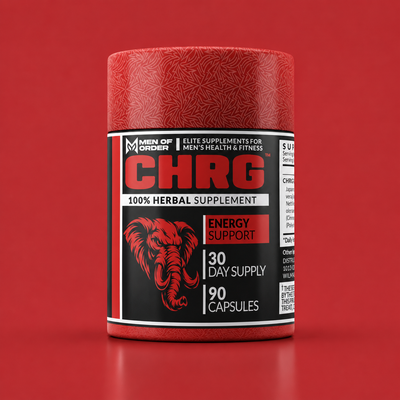
1. CHRG by Men of Order — full lifecycle coverage
We built CHRG specifically to cover all four jobs, so let's run it through the same framework:
- Build: Trans-resveratrol (SIRT1/AMPK signaling; a small human study found increased mitochondrial capacity when combined with exercise and piperine) and sulforaphane from broccoli floret
- Protect: Sulforaphane, one of the most potent Nrf2 activators studied (in laboratory research), plus black cumin seed
- Clear: Spermidine-supporting and mitophagy-relevant compounds including natto extract and nettle leaf
- Fuel: Japanese natto extract with nattokinase and vitamin K2 (MK-7) for circulation and oxygen delivery
Seven ingredients. All four jobs. Named ingredients with disclosed doses. $49 per bottle, or $39.20 with Subscribe and Save. That works out to roughly $1.31 to $1.63 per day, versus about $2.30 per day for a single bottle of Mitolyn.
Same honesty rules apply to us: CHRG's evidence is ingredient-level; it's not instant (expect 2 to 4 weeks, not 20 minutes), and it's a supplement, not a substitute for sleep and training. If you want to see exactly how we think a mitochondrial formula should be evaluated, read our full buyer's guide: how to evaluate any mitochondrial supplement.
[CHRG — $49 / $39.20 Subscribe & Save — free shipping over $40]
2. The DIY route
You can buy Rhodiola, Astaxanthin, and CoQ10 separately and build your own stack. Pros: full dose control. Cons: you'll likely spend more than $69/month to match a real formula, you'll swallow 5 or 6 capsules a day, and you're guessing at combinations. Fine for biohackers. Tedious for everyone else.
3. Single-ingredient options
CoQ10 is the classic mitochondrial supplement, and it supports one part of the engine (the electron transport chain). PQQ showed mitochondrial biogenesis signals, mostly in animal and lab research so far. Both are legitimate. Both are single answers to a four-part problem. We break both down in detail in the mitochondrial supplements guide.
If you're also weighing stimulant-based options, that's a different conversation. Caffeine borrows energy; it doesn't make it. We cover that here: stimulant-free energy, explained.
Frequently Asked Questions
Does Mitolyn work? Its ingredients have varying levels of research support, with Rhodiola and Astaxanthin the strongest. The finished formula itself has no published clinical trial, so results come down to the individual. Some users report improved energy over 2 to 3 months; others report minimal change.
Is Mitolyn legit? It's a real product made in a GMP-certified, FDA-registered facility, sold with a 90-day guarantee. It's legitimate in that sense. The main cautions are undisclosed ingredient doses, premium pricing, and buying only from the official site to avoid counterfeits.
What are the ingredients in Mitolyn? Maqui Berry, Rhodiola Rosea, Haematococcus (Astaxanthin), Amla, Theobroma Cacao, and Schisandra. Six plant-based ingredients, no stimulants.
Are there any Mitolyn side effects? The formula is plant-based and generally well tolerated. Some users report mild digestive discomfort early on. As with any supplement, talk to your doctor first if you take prescription medication or have a medical condition.
How much does Mitolyn cost? At the time of writing (September 2026): around $69 for one bottle, $59 per bottle in a 3-pack, and $49 per bottle in a 6-pack. Prices and promotions change, so check the official site.
What is the best alternative to Mitolyn? If you want the same stimulant-free approach with coverage of all four mitochondrial jobs (Build, Protect, Clear, Fuel) and disclosed doses, CHRG is built exactly for that. Single-ingredient options like CoQ10 cover one job each.
The Bottom Line
Mitolyn is a legitimate, stimulant-free, antioxidant-led formula with a good guarantee and a premium price. It protects mitochondria well. It doesn't build, clear, or fuel them.
Whichever direction you go, you now have the yardstick: four jobs, dose transparency, honest evidence, sane timeline claims. Ask every product those questions, including ours.
If you're tired of being tired and want the version built around all four jobs, CHRG is here. And if you want to understand why your mitochondria got sluggish in the first place, start here: why mitochondria decline makes you tired.
These statements have not been evaluated by the Food and Drug Administration. This product is not intended to diagnose, treat, cure, or prevent any disease.