Mitochondrial Supplements: What They Are, How They Work, and How to Tell the Real Ones from the Hype
Men of OrderSomewhere between the third podcast and the fifteenth ad, you heard it: "mitochondria is the powerhouse of the cell."
The pitch writes itself. Your energy is declining because your cellular power plants are failing, and this bottle will fix them.
Here's the honest answer: the science underneath that pitch is real. Mitochondria do decline with age, and that decline does show up as the afternoon wall, the flat workouts, the tiredness that sleep doesn't fix.
The question was never whether the biology holds. It's whether the bottle in the ad actually matches the biology.
Most don't. This guide will show you why, and how to tell the difference in about two minutes per product.

What Mitochondria Actually Do
Every move you make and every thought you think runs on a molecule called ATP.
Mitochondria are the structures inside your cells that manufacture it.
You carry roughly 37 trillion cells, and the hardest-working ones are packed with these power plants. Your heart cells alone hold about 5,000 mitochondria each, more than a third of the cell's volume, because your heart never gets a day off.
Here's the part that explains your last few years: mitochondria decline with age.
Starting around your mid-30s, your body builds fewer new ones, and the existing fleet works less efficiently.
Less mitochondrial capacity means less ATP. Less ATP means every system runs at reduced power, and the first place you feel it is in sustained daily energy.
So yes, "mitochondrial support" is a legitimate category.
Supporting the machinery that makes your energy is a fundamentally different project from blocking the signals that tell you you're tired.
One is construction.
The other is a muffler on the gauge.
The catch is that "supporting mitochondria" is not one job.
It's four.
And that single fact is the key to reading every product in the category.
[Why declining mitochondria make you tired all the time]
 The 4 Jobs a Real Mitochondrial Supplement Must Do
BUILD. Construct new mitochondria.
The master switch is a pathway called SIRT1 → AMPK → PGC-1α.
Activating it triggers mitochondrial biogenesis: brand-new power plants.
This is the job that actually raises your capacity.
Without it, everything else is maintenance on a shrinking fleet.
PROTECT. Defend the mitochondria you have.
Energy production throws off oxidative stress as exhaust, and that stress damages the machinery itself.
The Nrf2 pathway is the body's antioxidant shield, and activating it keeps existing power plants running longer.
CLEAR. Demolish the damaged ones.
Broken mitochondria don't just underperform.
They leak debris and oxidative byproducts that clog the whole system.
A cleanup process called mitophagy removes them.
Without clearing, you're protecting wreckage.
FUEL. Supply the production line.
The electron transport chain, where ATP is actually assembled, needs oxygen delivery and raw inputs.
Circulation support and key compounds like CoQ10 and vitamin K2 keep the line fed.
Four jobs.
Most mitochondrial supplements cover one or two.
The rest of the category is selling you a quarter of the answer at full price.
[How to get energy without caffeine]

The Ingredient Evidence, Honestly Tiered
Not all "clinically studied" claims are equal.
Here's where the major ingredients actually stand.
Human evidence tier: the credible core.
- Resveratrol (trans form, from Japanese knotweed). The BUILD signal. In a small clinical study, resveratrol with piperine produced a roughly 400% greater increase in muscle mitochondrial capacity versus placebo (16 young adults, alongside an exercise program).* Small study, exercise-dependent, but human data on the biogenesis pathway itself.
- CoQ10. A FUEL compound with decades of research. Your cells use it directly in the electron transport chain, and levels decline with age. Solid maintenance evidence, especially cardiovascular. What it can't do: activate biogenesis. It feeds the assembly line you have. It doesn't build you more line.
- Black cumin seed oil (standardized thymoquinone). PROTECT, with a stress angle. In a clinical study of endurance runners, a standardized black cumin oil was associated with 44% lower cortisol under marathon stress.* Industry-funded and small, but human and randomized.
Mechanism tier: strong lab signals, thin human data.
- Sulforaphane (from broccoli floret). The most potent known natural activator of the Nrf2 shield. In cell assays it induced the NQO1 defense enzyme at dramatically lower concentrations than other Nrf2 activators.* Impressive, and worth having, but that's in-vitro potency, not a human outcome.
- Ceylon cinnamon. BUILD plus CLEAR signals through the AMPK pathway and mitophagy support, demonstrated in cell and animal work. Chosen over cheap cassia cinnamon for its far lower coumarin content.
- PQQ. Marketed hard as a biogenesis ingredient. The biogenesis signals are mostly from animal and cell studies. Human evidence is thin, and standalone PQQ is usually overpriced for what it delivers. Not useless. Overhyped.
Emerging tier: real science, young evidence.
- NAD+ precursors (NR, NMN). NAD+ declines steeply with age and every mitochondrial reaction needs it. Restoring it is genuinely promising. But most headline results are still in animal models, and quality NR/NMN costs $2 to $5 per day for effects many users can't feel. A bet, not a foundation.
*Based on clinical trials of single ingredients. Each study tested an isolated compound under specific conditions, not a combined formula.

A Word on ATP Supplements and PQQ Supplements
Two category searches deserve direct answers, because buyers type them constantly.
ATP supplements. Swallowing ATP sounds logical.
Your body runs on ATP, so eat ATP.
The problem is bioavailability: oral ATP is broken down in the gut before it reaches your cells in any meaningful amount.
Your body makes roughly its own weight in ATP every day, inside the cells that use it.
You cannot stockpile it from a capsule.
Supporting the machinery that makes ATP works. Swallowing the end product doesn't.
PQQ supplements. Covered above, but worth repeating in one line: promising mechanism, thin human evidence, premium price.
If a formula includes it as one of several ingredients, fine. As a standalone purchase, your money goes further elsewhere.

How to Evaluate Any Mitochondrial Supplement
Two minutes per product, five questions:
- Coverage. Does it address all four jobs (build, protect, clear, fuel), or one? Single-ingredient products answer a quarter of the problem.
- Transparency. Are the ingredients named with their forms, or hidden in a proprietary blend? Blends exist to hide underdosing.
- Evidence honesty. Does the brand admit its evidence comes from single-ingredient studies, or does it imply the formula itself was clinically trialed? The second is a red flag. Almost no formula in this category has been trialed as a whole.
- Timeline realism. Does it promise energy in 20 minutes, or 2 to 4 weeks? Mitochondrial support works on the construction clock. Instant claims mean stimulants in disguise.
- Cost per day. Calculate it at real doses. Anything over $2 a day needs to justify itself with coverage and evidence, not packaging.
Run any product through that list and the category sorts itself fast.
[How the best energy supplements for men compare under this framework]
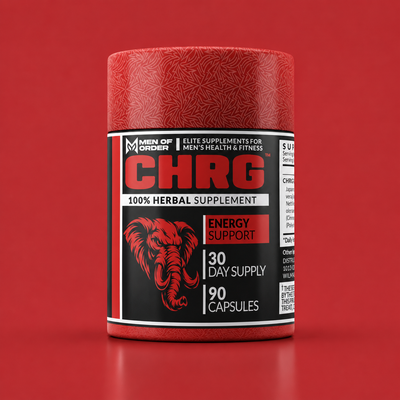
 CHRG, Run Through Its Own Checklist
We built CHRG, so apply whatever discount you think that deserves. Then check the math yourself.
Coverage: Seven ingredients mapped to all four jobs.
Trans-resveratrol and ceylon cinnamon for BUILD. Sulforaphane, black cumin, and nettle for PROTECT.
Cinnamon and sulforaphane for CLEAR. Japanese natto extract with vitamin K2 and nettle for FUEL.
Pistachio polyphenols supporting the build pathways. We are not aware of another formula that covers the full lifecycle.
If you find one, compare labels.
Timeline:
Week 1 IGNITE
Week 2 SUSTAIN
Week 3 COMPOUND.
Most men feel the first shift in weeks one to two, building over two to four weeks.
No 20-minute promises, because there is no caffeine and no stimulant in it.
Cost: $49 a bottle, or $39.20 on Subscribe & Save.
About $1.31 a day, free shipping over $40.
The honest limitations: it's not instant, it's not cheap, and the evidence base is ingredient-level.
Same as everyone in the category, except we say it out loud.
[CHRG: Energy Recharge. The full lifecycle in one formula. →]
Frequently Asked Questions
Do mitochondrial supplements work? The honest answer is layered. The biology is real: mitochondria decline with age, and that decline affects daily energy. Ingredients with human evidence (resveratrol, CoQ10, standardized black cumin) show measurable effects on pieces of the machinery. What doesn't work is expecting stimulant-speed results. Mitochondrial support works over two to four weeks of consistent use, and it compounds. On that clock, yes, the good ones work.
What is the best supplement for mitochondria? One that covers the full lifecycle: biogenesis (build), antioxidant defense (protect), mitophagy (clear), and delivery (fuel). Single ingredients like CoQ10 or PQQ each address a fragment. Judge any product by named ingredients, evidence honesty, and realistic timeline claims before price.
How can I improve my mitochondrial function? Three free foundations first: regular exercise (the best-proven biogenesis trigger), quality sleep, and stable blood sugar. Then targeted compounds: resveratrol for the build pathway, sulforaphane for antioxidant protection, and circulation support for fuel. The combination of lifestyle triggers plus targeted ingredients beats either alone.
What are the signs of poor mitochondrial function? The everyday pattern: energy that fades by early afternoon no matter how you slept, workouts that feel flatter than they should, slower recovery, and a general sense of running at reduced power. These are common and usually reflect normal age-related decline. If your fatigue is sudden, severe, or comes with other symptoms, see a doctor instead of a supplement page.
Are ATP supplements worth it? No, in capsule form. Oral ATP is largely broken down during digestion before it can reach your cells. Your body manufactures its own ATP supply inside the cells that use it. Supporting the production machinery is the effective route; swallowing the end product is not.
How long do mitochondrial supplements take to work? Typically two to four weeks of daily use before the first noticeable shift, with effects building over eight to twelve weeks as biogenesis accumulates. Any product in this category promising same-day energy is either stimulant-based or overpromising.
The Bottom Line
The mitochondria pitch in the ads is built on real science. That's exactly why it works as marketing. Your power plants do decline, and rebuilding them is a legitimate project.
But it's a four-part project. Build, protect, clear, fuel. The next time a bottle promises you cellular energy, count how many of the four it actually covers.
The category is real. Demand the full job.
[Start your 2-week energy protocol →]
These statements have not been evaluated by the Food and Drug Administration. This product is not intended to diagnose, treat, cure, or prevent any disease.