CoQ10 Alternatives for Mitochondrial Energy: What Actually Works Upstream
Men of OrderYou did the homework. Your energy started slipping, someone said the word "mitochondria," and you found CoQ10. It's in every energy aisle, every "best supplements" list, every forum thread about fatigue after 40.
So here's the question worth asking before you buy another bottle: is a cofactor enough?
CoQ10 is a legitimate, well-studied nutrient. We're going to give it full credit, explain exactly what it does inside your cells, why your levels drop, and where the evidence genuinely lands. Then we're going to show you the one thing it was never designed to do... and what it does instead.

What CoQ10 Actually Does
Inside every mitochondrion, there's an assembly line called the electron transport chain. It's the final stage of energy production, where electrons from the food you ate get passed down a series of protein complexes, and that flow is what ultimately charges the production of ATP, your cell's energy currency.
CoQ10's job is courier. It shuttles electrons from Complex I and Complex II over to Complex III, keeping the line moving. It also doubles as an antioxidant, patrolling the fatty membranes of your cells and mitochondria and neutralizing the exhaust the whole process throws off.
Think of it like a bucket brigade. The complexes are the firefighters. CoQ10 is the guy running buckets between them. If he's slow or scarce, the whole line backs up.
Your body makes its own CoQ10. You also get small amounts from food, mostly organ meats and oily fish. So far, so good. The problem is what happens next.

Why CoQ10 Levels Fall
Two things work against you, and both are well documented.
Age. Your body's CoQ10 production declines as you get older. The factory that makes the courier slows down right around the time everything else starts feeling slower too.
Statins. This is the one most men never hear about. Statins work by inhibiting a biochemical pathway called the mevalonate pathway, which is how your body makes cholesterol. Here's the catch: that same pathway is also how your body makes CoQ10. Inhibit one, and you reduce the other. It's basic biochemistry, not controversy.
Which explains a lot about who's shopping for CoQ10. Men over 40, many of them on a statin, many of them wondering why their energy and their legs aren't what they were. If that's you, this next part matters, so read it carefully: never start, stop, or adjust any medication based on an article, including this one. That's a conversation for your doctor.

What the Evidence Says for Energy
Now the honest tiering, because you deserve the real picture.
The strongest CoQ10 research sits in specific clinical populations under medical supervision. For healthy adults looking for more everyday energy, the evidence is real but modest and mixed. Some studies show benefit, some show little, and results depend heavily on dose, form, and who's being studied.
On dose and form: most supplements run 100 to 200 mg per day. CoQ10 is fat-soluble and notoriously poorly absorbed, so take it with food that contains fat or much of it passes through unused. You'll also see two forms marketed: ubiquinone and ubiquinol (the reduced form). Ubiquinol is sold as the better-absorbed premium option; whether that difference matters much in the real world is still debated.
Bottom line on CoQ10 itself: it's a real molecule doing a real job, with reasonable evidence in the right contexts. If someone tells you it's useless, they're wrong. But if someone tells you it's the complete mitochondrial answer, they're wrong too. Here's why.

The Limit: A Cog, Not the Blueprint
Here's the question almost nobody asks about CoQ10: what if the problem isn't the courier?
CoQ10 supports the electron transport chain inside the mitochondria you already have. It keeps existing machinery running. But it does not signal your cells to build new mitochondria. It does not activate the protective pathways that shield them from damage. It does not help clear out the broken ones clogging the system. It is a cog in the engine. A good cog. But if your energy problem is that the engine itself has shrunk- fewer mitochondria, older mitochondria, damaged mitochondria- then no amount of cog-polishing rebuilds it.
At Men of Order, we evaluate every mitochondrial supplement against the four jobs your cells actually need done:
- Build — triggering mitochondrial biogenesis, making new mitochondria (the SIRT1/AMPK/PGC-1α pathways)
- Protect — defending mitochondria from oxidative damage (the Nrf2 pathway)
- Clear — removing old, broken mitochondria (mitophagy)
- Fuel — delivering oxygen and nutrients so the mitochondria can run (circulation, blood flow)
Map CoQ10 onto that framework and you get a partial check on Fuel, at best. The other three jobs, the ones that determine how many mitochondria you have and what shape they're in, are untouched.
That's not a knock on CoQ10. It's just scope. And it's exactly where the alternatives come in.

The Upstream Alternatives
If CoQ10 maintains the engine, these are the compounds that tell the cell to expand it, armor it, clean it, and feed it. Same honesty rules apply: we'll tell you the evidence tier on each.
Resveratrol — the Build signal
Trans-resveratrol activates the SIRT1/AMPK axis, which switches on PGC-1α, the master regulator of mitochondrial biogenesis. This is the "make more mitochondria" pathway, the one CoQ10 never touches.
The human evidence is early but real: in a small clinical study (16 young adults), 500 mg of resveratrol combined with piperine and an exercise program produced a roughly 40% increase in skeletal muscle mitochondrial capacity versus about 10% with exercise alone. Caveats, stated plainly: small study, resveratrol-plus-piperine rather than resveratrol alone, and the benefit was exercise-dependent. The famous endurance study behind resveratrol was done in mice, so anyone quoting you doubled endurance as a human claim is overselling. The mechanism, though, is one of the most studied in all of longevity science.
Sulforaphane — the Protect and Clear signal
Sulforaphane, from broccoli, is among the most potent natural activators of Nrf2, the pathway that switches on your cells' own antioxidant defenses. In laboratory cell research, it activated a key defense enzyme at concentrations roughly 105 times lower than resveratrol, a striking in-vitro potency finding, though lab potency is not the same as a human outcome. It also supports autophagy and mitophagy, the Clear job: your cells' recycling system for broken mitochondria.
PQQ — the one you'll ask about
PQQ (pyrroloquinoline quinone) is the other "biogenesis" ingredient you'll see in this conversation, often pitched as CoQ10's partner. The biogenesis signals are interesting, but they're mostly from animal and lab research so far; human evidence is thin. Legitimate, promising, early. We'd file it under "watch this space," not "proven answer."
Nattokinase — the Fuel leg
Even a brand-new mitochondrial fleet stalls without oxygen. Nattokinase (from Japanese natto, paired naturally with vitamin K2 as MK-7) supports healthy circulation and blood flow, the delivery system that feeds the electron transport chain. In one head-to-head clinical study, it showed meaningful cardiovascular effects over 26 weeks, though the research base is still developing. One important note: nattokinase has natural blood-thinning properties, so anyone on anticoagulants or cardiovascular medication needs to talk to their doctor first. That applies to several ingredients in this category, resveratrol included.

Single Ingredient vs Full Lifecycle
So you could go the DIY route. CoQ10, plus resveratrol, plus a sulforaphane supplement, plus nattokinase, plus piperine for absorption. Now you're at five or six capsules a day, well over $80 a month at research-grade doses, and you're personally managing interactions and timing.
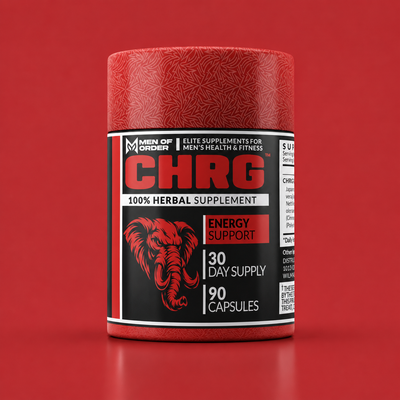
This is the exact problem we built CHRG to solve. Seven ingredients, chosen so all four jobs get covered in one formula:
- Build: trans-resveratrol from Japanese knotweed (the SIRT1/AMPK axis), Ceylon cinnamon, broccoli floret
- Protect: sulforaphane from broccoli floret, black cumin seed, nettle leaf (the Nrf2 shield)
- Clear: Ceylon cinnamon and sulforaphane (mitophagy and autophagy support)
- Fuel: Japanese natto extract with nattokinase and K2 (MK-7), plus nettle leaf
No caffeine, no stimulants. $49 per bottle, or $39.20 with Subscribe and Save, which works out to about $1.31 to $1.63 per day. Free shipping over $40. Same honesty rules as everything above: CHRG's evidence is ingredient-level, built on clinical trials of single ingredients; the finished formula hasn't been trialed, nobody's has. Expect weeks, not minutes. Most men feel the first shift in weeks 1 to 2, and it compounds from there.
And one more honest note: CHRG doesn't claim to replace CoQ10. Plenty of men take both, since they do different jobs. Whether that's right for you is your call, ideally made with your doctor.
[CHRG — $49 / $39.20 Subscribe & Save — free shipping over $40]
If you want the full framework for judging any mitochondrial supplement before you spend a dollar, read our buyer's guide: how to evaluate any mitochondrial supplement.
Frequently Asked Questions
What is a good alternative to CoQ10? It depends on what you're trying to do. CoQ10 supports the electron transport chain in existing mitochondria. If you want to support the growth of new mitochondria, resveratrol (SIRT1/AMPK pathway) is the most studied signal. For antioxidant defense, sulforaphane (Nrf2 pathway). For circulation and oxygen delivery, nattokinase. Full lifecycle formulas like CHRG combine all four jobs.
Is ubiquinol better than ubiquinone? Ubiquinol is the reduced form of CoQ10 and is marketed as better absorbed. Some evidence supports improved bioavailability, but whether that translates to meaningfully better real-world results is still debated. Either form should be taken with food containing fat.
CoQ10 vs PQQ: which is better for mitochondria? They do different things. CoQ10 is an electron courier and antioxidant inside existing mitochondria, with deeper human research. PQQ shows mitochondrial biogenesis signals, but mostly in animal and lab studies so far. "Better" depends on whether your goal is maintaining machinery (CoQ10) or signaling new growth (PQQ's claim, still early).
Does CoQ10 actually give you energy? CoQ10 isn't a stimulant, so you won't feel it like caffeine. The strongest evidence for measurable benefit is in specific clinical populations. In healthy adults, evidence for everyday energy is real but modest and mixed. Effects, when they occur, build over weeks.
Should you take CoQ10 if you're on a statin? Statins reduce the body's CoQ10 synthesis because cholesterol and CoQ10 share the same production pathway. Many doctors are aware of this. Whether to supplement is a decision to make with your doctor, who knows your full medication picture. Never adjust a prescription based on an article.
Can you take CoQ10 with resveratrol? There's no known conflict; they work on different parts of mitochondrial biology (electron transport vs biogenesis signaling). Both are fat-soluble, so take them with a meal containing fat. As always, check with your doctor if you're on any medication.
The Bottom Line
CoQ10 keeps the lights on in the mitochondria you have. It earned its reputation. But it's a cog, not a blueprint: it doesn't build new mitochondria, doesn't activate the protective shield, doesn't clear the wreckage.
The alternatives work upstream, on the signals that decide how many mitochondria you have and what condition they're in. That's the difference between maintaining a shrinking engine... and rebuilding it.
Whichever route you take, you now know the four questions to ask any product: does it Build, Protect, Clear, and Fuel? Including ours. If you want the formula built around all four, CHRG is here. And if you're still figuring out why your energy slipped in the first place, start here: why mitochondria decline makes you tired.
These statements have not been evaluated by the Food and Drug Administration. This product is not intended to diagnose, treat, cure, or prevent any disease.