Why Am I So Tired All the Time? The Real Reason Men Crash After 40
Men of OrderYou got eight hours of sleep. You had your coffee, maybe two. And yet here you are at 2:47 PM, staring at a screen, rereading the same sentence for the third time.
Your legs feel heavy. Your brain feels padded. And the day isn't even close to done.
If you've typed "why am I so tired all the time" into a search bar, you've probably already noticed something strange: the usual fixes stopped working. More sleep doesn't fix it. More coffee makes it worse. And everyone around you seems to be running on a fuel you can't find.
Here's the truth most articles won't tell you: tired isn't a feeling. It's a cellular emergency. And once you understand where energy actually comes from, really comes from, the crash stops being a mystery.
Let's rule out the usual suspects first. Then we'll open the hood.
The Basic Checklist: Stop here first.
Before we talk cells and engines, you need to cross off the boring stuff, because sometimes tired really is simple.
Sleep quality, not just sleep quantity. Eight hours of fragmented, shallow sleep is not eight hours of recovery. Alcohol, late screens, and untreated snoring all chop your sleep into pieces. If you wake up unrefreshed no matter how long you're in bed, sleep quality is suspect number one.
Vitamin and mineral gaps. This is worth an actual blood test, not a guess. The deficiencies most often linked to fatigue:
- Vitamin B12 — required for red blood cell production and nerve function. Low B12 means less oxygen delivered everywhere.
- Vitamin D — chronically low in most men who work indoors, and linked to low energy and low mood.
- Iron — less common in men than women, but low ferritin will flatten you.
Stress and cortisol. Chronic stress keeps cortisol elevated, and elevated cortisol all day means a body that never downshifts. You feel wired at midnight and hollow at noon.
Blood sugar swings. A heavy-carb lunch sends glucose up and then crashing down, and your energy follows it off the cliff.
And one more thing, said plainly: if your fatigue is sudden, severe, or comes with other symptoms (unexplained weight change, shortness of breath, chest pain, depression), skip this article and see a doctor. Fatigue is sometimes a signal worth taking seriously.
But if you've checked these boxes and you're still watching the clock every afternoon... then your problem is probably somewhere else entirely.
Somewhere smaller. Much smaller.
Caffeine: Why Your Second Coffee Just Isn't Doing it for you anymore
Caffeine doesn't create energy. It doesn't add a single unit of fuel to your body. What it does is block adenosine, the chemical your brain accumulates throughout the day that tells you you're tired. Caffeine doesn't remove the tiredness signal. It just covers the sensor.
Think of it like this: caffeine borrows energy. Then your body pays it back... with interest.
The adenosine doesn't disappear while you're caffeinated. It keeps building. And when the caffeine wears off, the whole backlog hits at once. That's the crash. That's the 3 PM wall.
Worse: your brain adapts. It grows more adenosine receptors to compensate, which means you need more caffeine to feel the same block. The first cup becomes maintenance. The second cup becomes survival. The third cup does nothing except make your hands shake.
So you end up in the loop: tired → caffeine → brief lift → bigger crash → more caffeine → worse sleep → more tired.
That's not an energy strategy. That's a payday loan.
The reason none of this fixes your fatigue is that caffeine operates downstream, at the signal level. It never touches the place where energy is actually made. You're treating the exhaust pipe, not the engine.
And no stimulant on earth fixes a broken engine.
Ready to get off the loan entirely? Here's how to get energy without caffeine.
Energy: The 37 Trillion Electricity Plants in Your Body
Every move you make, every thought you think, every heartbeat runs on a molecule called ATP. And ATP is manufactured inside structures called mitochondria, the energy producers of your cells.
You're carrying roughly 37 trillion cells. The hardest-working ones are packed with mitochondria: your heart cells alone hold about 5,000 mitochondria each (more than a third of the cell's entire volume) because your heart never gets a day off.
Here's the part that explains your afternoons: mitochondria decline with age. Starting around your mid-30s, you produce fewer of them, and the ones you keep work less efficiently. Less mitochondrial capacity means less ATP. Less ATP means every system in your body runs at reduced power, and the first place you feel it is sustained, all-day energy.
That's why eight hours of sleep doesn't fix it. Sleep restores the worker. It doesn't rebuild the factory.
But here's the good news — and it's genuinely good news: your body already knows how to build new mitochondria. There's a master switch for it, a pathway researchers call SIRT1 → AMPK → PGC-1α. When that pathway activates, it triggers mitochondrial biogenesis, the construction of brand-new power plants — and the Nrf2 pathway acts as an antioxidant shield protecting the ones you have.
That's not a marketing angle. That's how your body already works when it has what it needs.
So the real question isn't "how do I stop being tired?" It's: how do I get that construction project running again?
The Mitochondrial Lifecycle
Most energy products do one thing. Caffeine masks. Sugar spikes. Most single-ingredient supplements poke one node of one pathway.
But mitochondria have a full lifecycle, and real, lasting energy means covering all four stages:

BUILD — Activate the SIRT1/AMPK/PGC-1α pathway to construct new mitochondria. This is the engine rebuild. (Trans-resveratrol from Japanese knotweed, ceylon cinnamon, pistachio polyphenols.)
PROTECT — Defend existing mitochondria from oxidative damage via the Nrf2 antioxidant shield. A power plant that rusts out doesn't help you. (Sulforaphane from broccoli floret, black cumin seed, nettle leaf.)
CLEAR — Remove damaged, dysfunctional mitochondria through mitophagy (cellular demolition of the units leaking debris). Dirty engines clog the whole system. (Ceylon cinnamon, sulforaphane.)
FUEL — Improve oxygen delivery and support Complex I of the electron transport chain (the assembly line where ATP is actually produced). (Japanese natto extract with vitamin K2, nettle leaf.)
The research behind these ingredients is worth understanding, honestly. In a small clinical study, resveratrol combined with piperine produced a roughly 400% greater increase in muscle mitochondrial capacity compared to placebo, in 16 young adults, alongside an exercise program.* In a separate clinical study of endurance runners, a standardized black cumin seed oil was associated with 44% lower cortisol under marathon stress.* And in cell assays, sulforaphane activated the NQO1 cellular-defense enzyme at dramatically lower concentrations than other known Nrf2 activators (a potency signal, measured in the lab).*
*Based on clinical trials of single ingredients. Each of these studies tested individual ingredients, often at specific doses and under specific conditions, not a combined formula. That's the honest picture, and it's still a picture most energy products can't paint at all.
Want to see how all four stages come together in one formula? [See how CHRG's 7 ingredients target each stage of the mitochondrial lifecycle →]
How to stop that feeling of being tired
The honest answer has two parts, and skipping the first one is a mistake.
Part one: the boring fundamentals still matter. Exercise is the single best-proven trigger of mitochondrial biogenesis; even brisk walking, done consistently, tells your body to build more power plants. Sleep quality, protein at breakfast instead of a carb bomb, sunlight in the morning. None of this is sexy. All of it works, and it works with everything else we're talking about.
Part two: give the construction crew its materials. The SIRT1/AMPK pathway doesn't activate on willpower. It responds to specific compounds: the builders, protectors, clearers, and fuels above. That's exactly why we built CHRG.
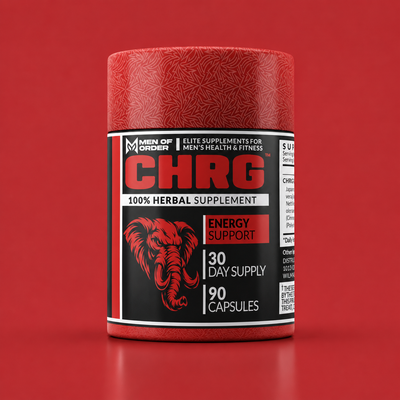
CHRG is 7 natural ingredients: Japanese natto extract, pistachio, black cumin, nettle leaf, broccoli floret, ceylon cinnamon, and Japanese knotweed, engineered to cover the complete mitochondrial lifecycle in one formula. Zero caffeine. Zero stimulants. Nothing borrowed.
Three capsules a day with a meal (take it with some fat, as these compounds are fat-soluble, and absorption matters). Then give it time, because building engines isn't flipping a switch:
- Week 1 — IGNITE. The build and protect phases kick in. Most men notice the afternoon wall starting to loosen its grip.
- Week 2 — SUSTAIN. Energy levels out. Not a spike, a floor that stops dropping.
- Week 3 — COMPOUND. The effect builds on itself. Stamina that doesn't come from a stimulant... because it isn't one.
Most men feel the first shift in weeks one to two, with results building over two to four weeks of consistent use.
One bottle is $49 or $39.20 on Subscribe & Save, every 31 days; cancel whenever. Free shipping over $40.
[CHRG — Energy Recharge. Stop borrowing energy. Start making it. →]
Frequently Asked Questions
Why am I so tired all the time even though I sleep enough? Because sleep restores the worker, it doesn't rebuild the factory. If your mitochondria have declined (a normal process that accelerates after your mid-30s), your cells produce less ATP no matter how rested you are. That's why tired-even-after-8-hours-of-sleep is such a common search: the energy production system is the bottleneck, not rest.
What vitamin deficiency causes fatigue? The big three are vitamin B12, vitamin D, and iron (ferritin). All three are detectable with a basic blood panel, and all three are worth ruling out before anything else. Ask your doctor for the test; don't guess.
Why do I crash every afternoon? Usually a stack of two things: blood sugar dropping after lunch, and caffeine wearing off while adenosine (the tiredness signal it was blocking) floods back in all at once. The underlying amplifier is low baseline cellular energy. Fix the production side and the afternoon crash loses most of its force.
How can I get energy without caffeine? Address the source instead of the signal: exercise (the most proven mitochondrial trigger), stable blood sugar, morning light, and compounds that support mitochondrial biogenesis and protection: resveratrol, sulforaphane, and the rest of the lifecycle stack. The full guide: energy without caffeine. It takes weeks, not minutes. But it's energy you wake up with, not energy you chase.
When should tiredness send me to a doctor? If it's sudden, severe, or comes with other symptoms (weight change, shortness of breath, chest pain, persistent low mood) get checked. Fatigue can be a signal of something that needs real medical attention, and no supplement article should talk you out of that.
The Bottom Line
Tired isn't who you are. It's not laziness, and it's not age "catching up" like some inevitable tax.
It's a maintenance issue. Your engines are under-built, under-protected, and overdue for a clearing, and every cup of coffee is just a louder exhaust pipe on the same clogged motor.
You'll either keep borrowing energy you don't have... or you'll start making it again.
Fix the engine. Not the exhaust.
[Start your 2-week energy reset — get 10% off your first order →]
These statements have not been evaluated by the Food and Drug Administration. This product is not intended to diagnose, treat, cure, or prevent any disease.