How to Get Energy Without Caffeine: The Man's Guide to Quitting the Loan Shark
Men of OrderDay three without coffee. Your head is throbbing. Your brain is wrapped in wet wool. You're staring at a spreadsheet that might as well be written in Greek, and a voice in your head is saying what it always says: just one cup. You function better with it. Why suffer?
Most men have lost this exact negotiation. Not because they lack discipline, but because they were solving the wrong problem.
The problem was never quitting caffeine. It's what you're quitting into. If caffeine was the only thing holding your energy up, then quitting it just leaves you standing in the hole it was covering.
Here's how to actually do it: understand what caffeine was doing to you, understand why removing it leaves you empty, and rebuild the system that should have been making your energy all along.
Why Does Caffeine Crash You?
Caffeine doesn't create energy. Not one unit of it. What it does is block adenosine, the chemical that accumulates in your brain throughout the day to signal tiredness. Caffeine plugs the receptor. The signal can't land.
Two problems follow.
First, the adenosine doesn't go away. It keeps building all afternoon, silently, like water behind a dam. When the caffeine wears off four to six hours later, the whole backlog floods in at once. That's the crash. That's the 3 PM wall that hits like a tranquilizer.
Second, your brain adapts. It grows extra adenosine receptors to get the signal through around the caffeine. Now you need more caffeine to get the same effect. The first cup becomes maintenance. The second cup becomes survival. The third cup mostly makes your hands shake.
And here's the part that locks the trap shut: caffeine lingers. Its half-life runs five to six hours, so your 3 PM rescue cup is still half active at 9 PM, cutting into the deep sleep that was supposed to restore you. You wake up already behind, and you reach for the pot.
Tired. Caffeine. Brief lift. Bigger crash. Worse sleep. More tired.
That's not an energy strategy. That's a payday loan, and the interest compounds nightly.
Why Quitting Cold Leaves You Empty
So you quit. Respect. But around day three you discover something worse than the headache: underneath the withdrawal, there's... nothing. No energy of your own waiting to rush back in.
This is the part nobody warns you about. Caffeine withdrawal is real but short: headache, fog, irritability, typically gone in two to nine days. What doesn't resolve in nine days is the thing caffeine was masking.
Your body makes energy (ATP) inside mitochondria, the power plants in your cells. Mitochondria decline with age, starting around your mid-30s: fewer of them, working less efficiently. Less capacity means less ATP, and less ATP means a man running at reduced power no matter how he sleeps or eats. Caffeine papered over that decline for years by muffling the tiredness signal. It never added a single power plant.
So when you quit, you're not broken. You're just finally seeing the real reading on the gauge. The withdrawal ends in about a week. The deficit underneath it is years old.
[Why you're tired even after 8 hours of sleep]
Which means the actual project isn't "quit caffeine." It's rebuild production, so you don't need the mask.
Where Real Energy Comes From
Your body already knows how to build new mitochondria. There's a master switch for it: a pathway researchers call SIRT1 → AMPK → PGC-1α. When it activates, it triggers mitochondrial biogenesis, the construction of brand-new power plants. A second pathway, Nrf2, acts as an antioxidant shield protecting the ones you already have. And a cleanup system called mitophagy demolishes the damaged units that leak debris and clog the works.
That's the whole game. Build new. Protect existing. Clear damaged. Fuel the line with oxygen and raw materials.

Three foundations are free, and skipping them is a mistake:
- Exercise. The single best-proven trigger of mitochondrial biogenesis. Even brisk walking, done daily, tells your body to build. Nothing in a capsule replaces this.
- Sleep quality. Not just hours. The deep-sleep phases are when cellular maintenance happens. Protect them: dark room, cool room, no late alcohol.
- Morning light. Ten minutes of outdoor light early in the day sets the body clock that governs energy rhythm. Boring. Effective.
Then there are the compounds that feed the construction crew: resveratrol for the SIRT1/AMPK build signal, sulforaphane for the Nrf2 shield, ceylon cinnamon for the cleanup, Japanese natto extract for circulation and oxygen delivery. This is the layer caffeine-free energy supplements are supposed to cover. Most don't, because most are one ingredient doing one job.
Coffee Alternatives That Actually Work
An honest tier list. No filler, no affiliate junk.
Tier 1: Ritual replacements. Decaf, chicory, herbal coffee blends. These solve the habit, the warmth, the morning mug. What they can't do: give you energy. They're a placebo for the ritual, which is genuinely useful in week one of a quit and useless for the deficit.
Tier 2: Acute non-stimulant lifts. A ten-minute walk, cold water on the face or a cold shower, a tall glass of water, protein at breakfast instead of a carb bomb. These move the needle for an hour or two by shifting circulation, blood sugar, or alertness chemistry. Free, immediate, and worth doing daily. What they can't do: raise your baseline. They're nudges, not construction.
Tier 3: Production rebuilders. Supplements that support the mitochondrial machinery itself. This is where "caffeine free energy supplement" stops being an oxymoron. The ones worth anything target the lifecycle: biogenesis activators (resveratrol), antioxidant shields (sulforaphane, black cumin), circulation and fuel (natto extract, nettle). The catch, and it's a real one: they work in weeks, not minutes. Two to four weeks of daily use before the shift is noticeable. But unlike every other tier, the effect compounds instead of depleting.
A natural caffeine replacement, in the honest sense of the phrase, is Tier 3 plus the free foundations. Everything else is a patch.
For the full mechanism-by-mechanism breakdown, see [how the best energy supplements for men compare]
The Caffeine Exit Plan
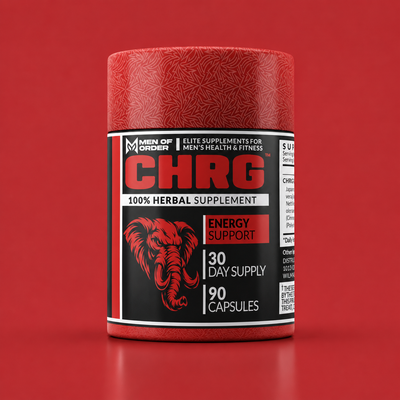
This is exactly why we built CHRG. Seven natural ingredients: Japanese natto extract, pistachio, black cumin, nettle leaf, broccoli floret, ceylon cinnamon, and Japanese knotweed (trans-resveratrol). Zero caffeine, zero stimulants. Together they cover the full lifecycle, Build, Protect, Clear, Fuel, instead of one corner of it.
The evidence is worth stating precisely. In a small clinical study, resveratrol with piperine produced a roughly 400% greater increase in muscle mitochondrial capacity versus placebo (16 young adults, alongside an exercise program).* In a clinical study of endurance runners, a standardized black cumin seed oil was associated with 44% lower cortisol under marathon stress.* In cell assays, sulforaphane activated the NQO1 cellular-defense enzyme at dramatically lower concentrations than other known Nrf2 activators.*
*Based on clinical trials of single ingredients. Each study tested an isolated compound under specific conditions, not a combined formula.
Here's how the quit actually runs. Taper the coffee over week one if you want to skip the headache. Start CHRG the same week: three capsules a day with a meal, taken with some fat because these compounds are fat-soluble. The first week is IGNITE, the build and protect phases kicking in while the withdrawal fog lifts. Week two is SUSTAIN: energy starts leveling out, no spike, just a floor that stops dropping. By week three, COMPOUND: stamina that doesn't come from a stimulant, because it isn't one.
Most men feel the first shift somewhere in weeks one to two. By week four, the interesting thing happens: you stop missing coffee. Not because you're white-knuckling. Because you don't need it.
One bottle is $49, or $39.20 on Subscribe & Save (20% off, every 31 days, cancel whenever). Free shipping over $40.
[CHRG: Energy Recharge. Quit the loan shark. Keep the energy. →]
Frequently Asked Questions
How can I get energy without caffeine? Two layers. Acute lifts for today: a short walk, cold water, hydration, protein at breakfast, morning sunlight. Baseline rebuild for the long term: exercise, sleep quality, and mitochondrial-support ingredients like resveratrol and sulforaphane. The first layer helps within minutes. The second is the one that makes caffeine unnecessary, and it takes two to four weeks.
What gives you energy besides caffeine? Everything on the production side: exercise (the most proven mitochondrial trigger), stable blood sugar, deep sleep, morning light, and compounds that support mitochondrial biogenesis and protection. What these share is that they raise your baseline rather than borrowing against it. That's the entire difference.
Why does caffeine crash you? Caffeine blocks adenosine, the brain's tiredness signal, without clearing it. Adenosine keeps building while you're caffeinated, and when the caffeine wears off, the accumulated backlog hits all at once. That's the crash. The longer-term cost is tolerance: your brain grows more receptors, so you need more caffeine for the same effect, and late-day caffeine degrades the sleep that was supposed to restore you.
Does caffeine free energy work? Yes, on a different clock. Stimulant energy works in twenty minutes and fades within hours. Caffeine-free, mitochondrial-support energy typically takes two to four weeks of consistent daily use to become noticeable, then compounds over the following weeks. Slower to start, and it doesn't crash. That trade is the whole point.
How long does caffeine withdrawal last? For most men, two to nine days. Headache, fog, and irritability peak around days two and three, then fade fast. What doesn't fade on its own is the underlying low baseline that made you depend on caffeine, which is why quitting works best when you rebuild production at the same time.
What is the best caffeine free energy supplement? One that covers the full mitochondrial lifecycle rather than a single ingredient: biogenesis (build), antioxidant defense (protect), mitophagy (clear), and circulation and oxygen delivery (fuel). Check the label for named compounds with human research behind them, and be suspicious of anything promising instant results. Instant and stimulant-free don't coexist.
The Bottom Line
You were never addicted to energy. You were addicted to the signal blocker, because the signal was telling the truth and you had no other way to deal with it.
Quit the loan shark by all means. Just don't leave the hole it was covering. Build the engine, and the mask becomes unnecessary.
You don't miss caffeine when you don't need it.
[Start your 2-week energy reset →]
These statements have not been evaluated by the Food and Drug Administration. This product is not intended to diagnose, treat, cure, or prevent any disease.