Sulforaphane: What It Is, How It Works, and What the Research Actually Shows
Men of OrderIf you spend any time in longevity or performance circles, you've heard the word. Sulforaphane. The compound that turned broccoli from a side dish into a supplement category.
The hype is loud. The molecule is real. And the gap between what sulforaphane actually does and what the internet says it does is wide enough to drive a smoothie truck through.
So let's do this properly. What it is, how it works, why the form you buy matters more than the dose on the label, and what the research genuinely supports. No miracle claims. No hedging into uselessness either.

What Is Sulforaphane?
Sulforaphane is an isothiocyanate, a sulfur-containing compound found in cruciferous vegetables: broccoli, Brussels sprouts, cabbage, kale. Broccoli is the richest common source, and broccoli sprouts and florets carry the highest concentrations of its precursor.
Here's the part most people never learn: sulforaphane doesn't exist in the plant.
What's in the plant is glucoraphanin, an inert storage molecule. Sulforaphane is only created when glucoraphanin meets an enzyme called myrosinase, and the plant keeps the two in separate compartments. They meet when the plant tissue is damaged: chopped, crushed, chewed. This is defense chemistry. The plant assembles its weapon at the moment of attack, like snapping a glow stick.
That one fact explains almost everything that goes wrong with sulforaphane supplements later. Keep it in your pocket.

How It Works: Nrf2, the Master Switch
Most "antioxidant" ingredients work directly. Vitamin C, vitamin E, CoQ10: they physically neutralize free radicals, one molecule at a time, and they're consumed in the process. A spent bullet.
Sulforaphane works differently, and the difference is the whole story.
Sulforaphane activates a pathway called Nrf2. Think of Nrf2 as the master switchboard for your cells' own defense systems. When Nrf2 switches on, your cells increase production of their own protective enzymes: glutathione-related enzymes, NQO1, heme oxygenase, and dozens of others. Your cells make their own defense force, on demand, at scale.
A direct antioxidant is a guard you hire. Nrf2 activation is training your entire staff in security. One runs out. The other compounds.
And Nrf2 is only the start. Research on sulforaphane also points to:
- AMPK and PGC-1α signaling — the same master pathway that tells cells to build new mitochondria (biogenesis)
- mTOR suppression and autophagy support — the cellular housekeeping systems that clear out damaged components, including broken mitochondria (mitophagy)
- Fasting-mimetic behavior — several of these effects resemble what happens during fasting, which is part of why longevity researchers pay attention to it
Defense, construction, and cleanup from one small molecule. That's why it shows up in serious formulas.

The 105× Number, Honestly
You may see a striking statistic attached to sulforaphane: that it's 105 times more potent than resveratrol at activating cellular defense enzymes.
It's a real number. Here's exactly what it means.
In laboratory cell research published in 2016 (Houghton and colleagues, Oxidative Medicine and Cellular Longevity), researchers measured how much of each compound it took to double the activity of NQO1, one of the defense enzymes Nrf2 controls. Sulforaphane did it at a concentration of 0.2 micromolar. Resveratrol needed 21 micromolar. That 105-to-1 ratio is where the headline comes from. The same study found sulforaphane 13.5 times more potent than curcumin by this measure.
Now the honest framing, because this is where marketing usually leaves the rails: this was a cell assay, not a human trial. Potency in a dish does not translate directly into results in a body. Digestion, absorption, metabolism, and dose all intervene. What this number tells you is that sulforaphane is a remarkably efficient Nrf2 activator at the cellular level. What it does not tell you is that it's "105 times better" for your health.
Real mechanism. Real number. Right-sized expectations. That's how you read research, and it's how we'll treat every claim in this article.

Forms: The Myrosinase Problem
Remember the glow stick. This is where it comes back.
Because sulforaphane doesn't exist until glucoraphanin meets myrosinase, every sulforaphane product faces the same engineering problem: how do the two meet inside you instead of never?
The food route. Raw or lightly steamed broccoli, broccoli sprouts, and cruciferous vegetables. Chopping and chewing releases myrosinase. But heat destroys the enzyme, so well-cooked broccoli delivers mostly unconverted glucoraphanin. Sprouts are the standout food source; mature heads carry less.
The cheap supplement route. Many budget supplements are glucoraphanin powder (often labeled "broccoli seed extract") with inactive or absent myrosinase. You're swallowing an unbroken glow stick. Conversion then depends on your gut bacteria doing the job, which is inconsistent person to person.
The done-right routes:
| Form | What's in it | Conversion reliability | Who it's for |
|---|---|---|---|
| Glucoraphanin alone | Precursor only | Low, gut-dependent | Budget option; roll of the dice |
| Glucoraphanin + active myrosinase | Precursor + the enzyme | High | Most people; the standard to look for |
| Stabilized sulforaphane | The finished molecule, stabilized | Highest | Premium tier; fewer products |
| Broccoli sprouts (food) | Precursor + native enzyme | High, if raw | DIY route; daily effort required |
Label reading rule: look for "glucoraphanin" AND "myrosinase" (or "active myrosinase") on the Supplement Facts, or a genuinely stabilized sulforaphane. If the label only brags about "broccoli extract" milligrams, that number tells you almost nothing about what your cells will receive.
Dosage Context
Straight answer: there is no established recommended daily allowance for sulforaphane, and human research has used a wide range of doses and forms, which makes precise dosing claims premature.
What the practical picture looks like:
- Human studies have generally used glucoraphanin or sulforaphane in amounts designed to deliver what a large daily serving of raw sprouts would provide, sometimes considerably more.
- Consistency beats megadosing. Nrf2 activation is a signaling effect, not a stockpiling effect. Regular daily intake matters more than heroic single doses.
- Take it with food. It sits comfortably alongside meals, and fat-containing meals support absorption of fat-soluble compounds it typically shares a formula with.
Anyone on prescription medication should run any new supplement past their doctor first. That advice applies everywhere, and it applies here.

Where Sulforaphane Fits in the Bigger Picture
Zoom out for a second, because no ingredient works in isolation.
At Men of Order, we evaluate mitochondrial support against four jobs your cells need done: Build new mitochondria (the SIRT1/AMPK/PGC-1α pathways), Protect existing ones from oxidative damage (Nrf2), Clear the broken ones (mitophagy), and Fuel the system with oxygen and circulation.
Map sulforaphane onto that framework and something jumps out: it's the only common ingredient that touches three of the four jobs. Protect, through Nrf2. Build, through AMPK/PGC-1α signaling. Clear, through autophagy and mitophagy support. What it doesn't do is Fuel: circulation and oxygen delivery belong to different compounds entirely.
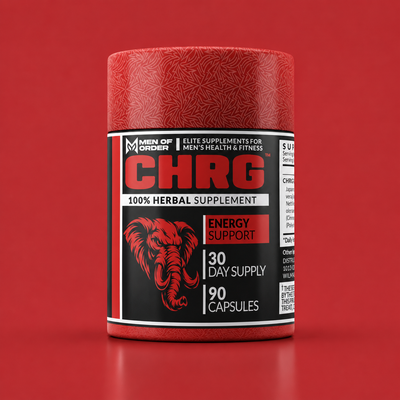
That's exactly why we built CHRG the way we did. CHRG contains broccoli floret as its sulforaphane source, alongside six other ingredients chosen so all four jobs get covered: trans-resveratrol from Japanese knotweed for the Build signal, Japanese natto extract with nattokinase and vitamin K2 for Fuel, black cumin, nettle leaf, Ceylon cinnamon. The full lifecycle in one formula, no caffeine, no stimulants.
$49 per bottle, or $39.20 with Subscribe and Save (about $1.31 to $1.63 per day), free shipping over $40. Same honesty rules as the rest of this article: CHRG's evidence is ingredient-level, based on clinical trials of single ingredients; the finished formula itself hasn't been clinically trialed, and most men feel the first shift in weeks 1 to 2, not minutes.
[CHRG — sulforaphane + 6 synergists — $49 / $39.20 Subscribe & Save]
If you want the full framework for evaluating any mitochondrial formula, read the pillar: how to evaluate any mitochondrial supplement. And for the Build-side counterpart to sulforaphane, see our breakdown of resveratrol and the SIRT1/AMPK axis.
Frequently Asked Questions
What is sulforaphane? A sulfur-containing compound (an isothiocyanate) created in cruciferous vegetables when the precursor glucoraphanin meets the enzyme myrosinase, typically through chopping or chewing. It's best known for activating Nrf2, the pathway that coordinates the body's own cellular defense enzymes.
What does sulforaphane do in the body? Its best-established role is activating Nrf2, which switches on the cell's internal antioxidant and defense systems. Research also points to support for mitochondrial biogenesis signaling (AMPK/PGC-1α) and cellular cleanup processes (autophagy and mitophagy). Most outcome research in humans is still early-stage.
What is the difference between glucoraphanin and sulforaphane? Glucoraphanin is the inert precursor stored in the plant; sulforaphane is the active compound created from it by the enzyme myrosinase. A supplement containing only glucoraphanin without active myrosinase relies on your gut bacteria for conversion, which is unreliable.
How much sulforaphane should you take? There is no official recommended dose, and human studies have used a wide range. Practical guidance: choose a form that reliably delivers sulforaphane (glucoraphanin plus active myrosinase, or stabilized sulforaphane), take it daily with food, and favor consistency over high doses.
Can you get enough sulforaphane from broccoli? Raw broccoli sprouts are the richest food source and can deliver meaningful amounts. Mature cooked broccoli delivers far less, because heat destroys the myrosinase needed to create sulforaphane. Lightly steamed or raw preparations preserve more.
Does sulforaphane have side effects? It's a food-derived compound and generally well tolerated. Some people report mild digestive discomfort at high doses. If you take prescription medication or have a medical condition, check with your doctor before starting any supplement.
Is sulforaphane better than resveratrol? They do different jobs. Sulforaphane is the standout for Nrf2-driven protection and cleanup; resveratrol is the standout for the SIRT1/AMPK biogenesis signal. In one laboratory cell study, sulforaphane activated a defense enzyme at concentrations 105 times lower than resveratrol, but that in-vitro potency comparison isn't a verdict on real-world results. They complement each other, which is why both appear in CHRG.
The Bottom Line
Sulforaphane earned its reputation the honest way: a real mechanism (Nrf2), an unusually wide reach (defense, biogenesis signaling, cleanup), and a research base that's promising even where it's still young.
One molecule, three jobs, one caveat: it has to survive the trip. Glucoraphanin without myrosinase is a glow stick nobody snapped. Read labels for the enzyme, not the milligrams.
And if you'd rather not assemble the four mitochondrial jobs piece by piece, CHRG covers all of them, broccoli floret included. If you're still working out why your energy dropped in the first place, start here: why mitochondrial decline makes you tired.
These statements have not been evaluated by the Food and Drug Administration. This product is not intended to diagnose, treat, cure, or prevent any disease.